
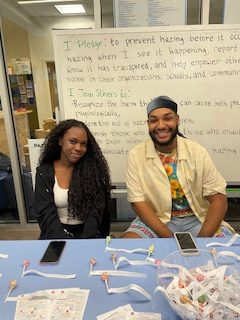
As students join different clubs, activities and other social groups, students must understand the importance of treating others with respect and kindness. Hazing is a practice in which a member of a group faces abuse, humiliation, and certain types of danger. Fraternity and Sorority Life hosted an array of events for Hazing Prevention Week, which was from September 22nd to September 26th, to educate students about the different types of hazing activities that people can inflict upon others and the negative impact of hazing on people. Students also learned what they can do to and whom they reach out to if they are a victim of hazing and/or know someone else who is a victim.
The flyer distributed by Fraternity and Sorority Life for Hazing Prevention Week highlighted important statistics on hazing. The source of each statistic was also cited. For example, the flyer states, “Forty-seven percent of students coming to college have experienced hazing (Hoover & Pollard, 2000).”
The events held during Hazing Prevention Week included “DWI Awareness,” held on September 22nd on Alumni Lawn, in which students used a DWI simulator. Students experienced what driving feels like when the person operating the vehicle is under the influence of alcohol.
On Tuesday, September 23rd, Fraternities and Sororities hosted an event called “I ring in respect,” in which students were given the opportunity take the national, anti-hazing pledge. On Thursday the 25th, students attended the “Donut haze” event, in which they were given donut and had the opportunity to sign the pledge.
Fraternity and Sorority Life also hosted the “Houses of Horror Screening,” held on September 24th. Students watched “Houses of Horror: Hazed to Death,” which discussed the death of Timothy Piazza, who was a student at the University of the Pennsylvania. Piazza was forced to drink a dangerous amount of alcohol by one of the fraternities at the school. After he consumed the alcohol, he fell down the stairs in the Fraternity house and passed away. A panel of staff members was at the event and answered questions students had about the screening and about hazing.
In addition, Fraternity and Sorority Life hosted two tabling events outside the Center for Student Engagement. “Hazing Trivia” was tabled by D’Andre Butler, a first-year graduate student in the Digital Media and Communication program with a concentration in filmmaking, and Shandreka McCullough, Assistant Director of Fraternity and Sorority Life on the Pleasantville.
For the event, students were asked a question about hazing, such as whether it is true or false that hazing always involves physical contact. This is false, as hazing can be non-physical. If a student answered the question correctly, they received a token to drop in the Prize Drop board. The type of prize that the student received depended on the slot the token landed in. For example, if the token landed in the “secret item” slot, the student received a compact power bank.
The “Don’t Be a ‘Dum-Dum’” event was tabled by D’Andre Butler and Ariel Smith, a junior majoring in Criminal Justice with a concentration in lawyering. At the event, students received a Dum-Dum lollipop, each lollipop had an important fact about hazing taped to it. For example, one of the facts stated, “Victims of hazing often feel isolated and ashamed, which can prevent them from seeking help or forming healthy relationships.”
D’Andre Butler discusses what he enjoys about tabling these two events. “When students come to the table, they are curious about hazing is and what can be done to address hazing. We get to arm them with important information on hazing and how to prevent it.”
The events held during Hazing Prevention Week offered students a pamphlet on hazing. Hazing can come in various forms. The pamphlet states that hazing can involve “sleep deprivation and being woken up in the night…making prank calls or harassing others…[and/or] being taken to and left at an unknown location.”
The pamphlet also highlights signs to be aware of that someone has been hazed. Such signs may include “chronic fatigue…symptoms of depression…[and/or] disrupted patterns of behavior or communication, [such as] not eating meals as usual.”
Shandreka McCullough discusses the people and centers students can go to if they are a victim of hazing or it they know someone who is a victim of hazing. “Hazing or suspicion of hazing can be reported to a university faculty or staff, an RA, and university security.”
If you have any questions about hazing and how to stop hazing on campus, please email Shandreka McCullough at [email protected].