
Man’s best friend has been celebrated for centuries for being loving, loyal, and joyful. However, scientists are continuing to study dogs’ brain patterns and uncover the truth of how dogs think.
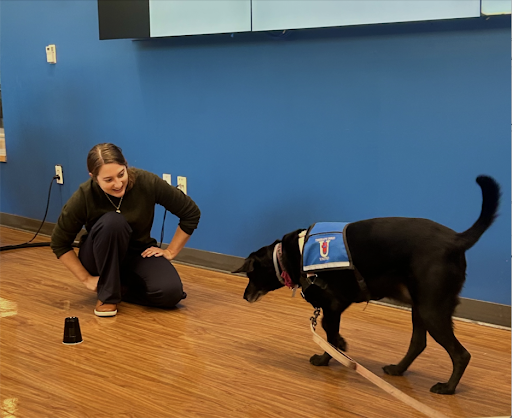
Professor Molly Byrne and her paw-fessor assistant, Anna, hosted a psychology of dogs seminar earlier this month. Anna, the Labrador retriever, is a six-year-old therapy dog used to study dog psychology. Professor Byrne and Anna demonstrated how dogs can learn from people, without understanding our language.
Dogs were domesticated from wolves because they can interpret human communicative cues. They are special in their ability to form close bonds with their owners and can even detect stress. Dogs are incredible at sensing things that humans can’t. Byrne states that “almost every dog can smell cancer, but the trick is to teach them how to tell us about it”.
The study of dog psychology “tends to focus on whether dogs understand the words and expressions that humans use” (Coren, Arden, Bekoff, Marano, & Bradshaw, 2017). Therefore, dog trainers have to take a different approach. This is what is commonly known as comparative cognition, where dog trainers study how to successfully communicate with dogs.
Professor Byrne’s seminar demonstrated how dogs respond to different methods of communication. One of those methods, is pointing. Professor Byrne presented Anna with two empty cups. Byrne then shielded Anna’s view of the cups and placed a treat under one of the cups. By simply pointing to the cup with the treat, Anna was able to uncover the reward.
Some people ask, why can’t Anna just sniff out where the treat is? To that, Byrne says that “wave taught them that this is a visual trick”, meaning that they are relying on instinct instead of smell.
Byrne then asked the audience to try to teach each other a new, nonsense, word without describing what the word means. For example, if I wanted to teach my friend Emilee that the word “spladoosh” means the action of patting your head, I would continuously pat my head while saying “spladoosh”. As soon as Emilee figured out what the word meant, we celebrated. Its seems silly, but this is how dogs learn the meaning of human words.
If Professor Byrne wanted to teach Anna how to sit, she would guide Anna into a sit and then reward her with a treat when she got it right. This positive reinforcement when Anna got the action right is called operant conditioning. Anna learns that when she matches the correct action to the correct word, she gets a treat.
Another method of training that Byrne uses is called scaffolding. This is where the dog trainer rewards the dog one step at a time. For instance, if Byrne wanted to teach Anna to roll over using scaffolding, she would reward Anna when she lays down, reward her again when she went on her back, and then reward her again when she rolled all the way over. This method of training helps dogs understand the steps to completing the full command.
If you find this interesting, consider taking Professor Byrne’s class entitled Animal Psychology, and the Human-Animal Bond. This class is a more in-depth study on the “understanding of animal cognitive capacities, their emotional functioning, as well as normative and abnormal behavior” (Pace University).
Alternatively, you can continue to learn from Anna the dog in Dr. Kimberly Collica’s class, Parenting, Prison, and Pups. The class is “an evidence-based parenting program provided to female jail-based prisoners” enhanced with animal-assisted therapy (Pace University).
Also, keep an eye out for the grand opening of the Dog Psychology Lab run by Professor Byrne. If you want to get more hands-on experience with dog psychology, email Professor Byrne at [email protected] for information.