
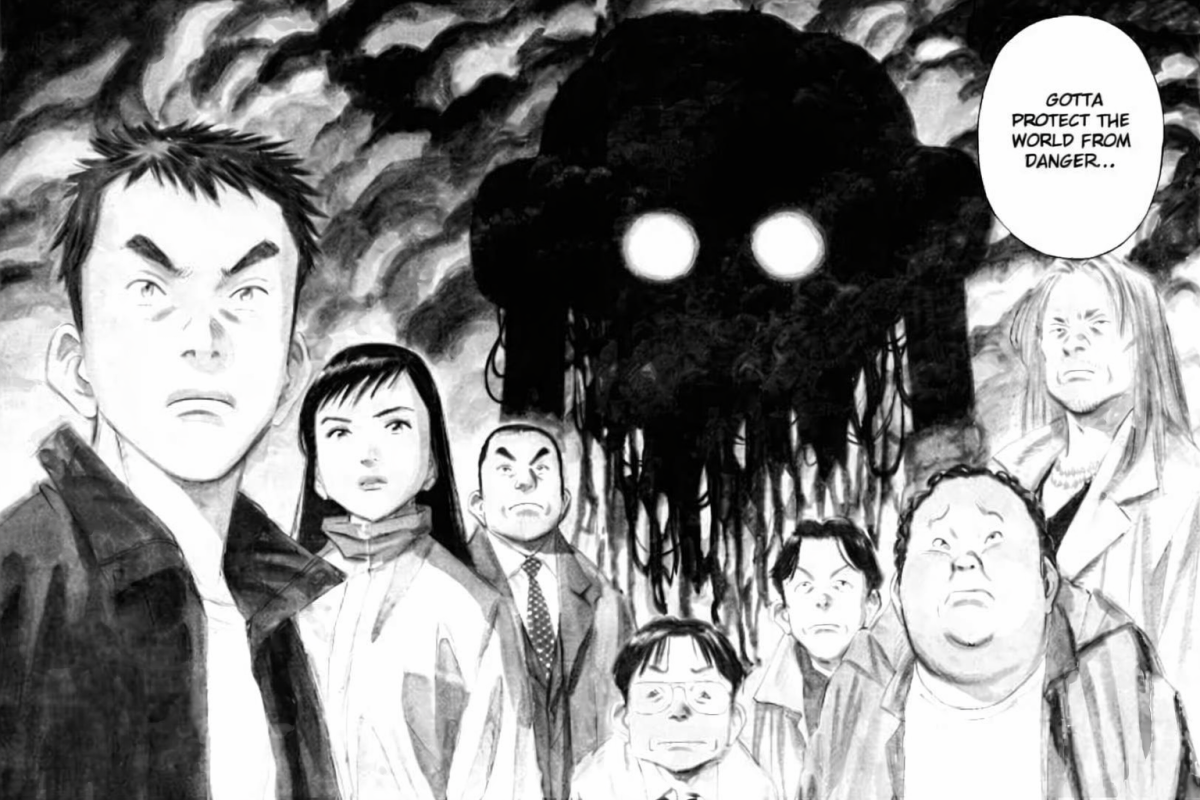
20th Century Boys is a manga created by Naoki Urasawa that ran from October 4, 1999, to April 24, 2006. The manga series is extremely popular, ranked #14 on myanimelist.com. If the name Naoki Urasawa sounds familiar, that is because he is also the man responsible for the popular series Monster, Billy Bat, and Pluto. Most of his stories are based on psychological thrillers and mysteries. 20th Century Boys, though, may be one of his greatest works yet.
20th Century Boys follows a group of friends, led by Kenji Endo, who must stop a mysterious cult leader known as “Friend” from destroying the world in the year 2000. As adults, they realize “Friend” plans on bringing forth doomsday based on a “prophecy” they invented as children. While the manga may be almost 30 years old, it has become one of my favorite stories ever, being rich in characters, mystery, and story.
The manga is heavily based on uncovering the mystery behind who “Friend” is, his intentions, and how he can be stopped. There are so many twists within the story that you truly have no idea what is for certain. I will say that the twists are fruitful and don’t feel pointless.
Something else that is done incredibly well is the handling of time jumps. Throughout the story, we follow three time periods: the late 60s/early 70s (Kenji’s Childhood), the late 90s (Kenji’s young Adulthood), and the 2010s (Kanna’s story, Kenji’s niece, wrapping into the world Kenji is a part of). Most pieces of media I have both read and watched always seem to do a horrible job at time skips, making things confusing, and messing it up with the whole back-and-forth notion. That is not a problem in this story, though. Everything works so well, whether it is to advance a story or explain a plot point. There are literally no plot holes at the end of the story. Despite practically three different stories being told, everything all comes together at the end, giving a satisfying conclusion to Kenji and his friends.
The two biggest things that stood out to me were the way the story allows you to sympathize with every character and the overall buildup of the antagonist of the story, “Friend.” Hitting on the first point, nearly all the characters you meet in the story are seen as elementary school children. The way that the story goes through different time periods allows you to truly feel sorry for all the characters in the story.
You see how bullying, self-esteem, confidence, and struggle with identity shape each character and ultimately lead them down the path they go down as adults. It causes the reader to feel sympathy for everyone involved, despite how evil they may be, because at the end of the day, you see the kid in them that was hurt. That helps segway into my next point, “Friend.”
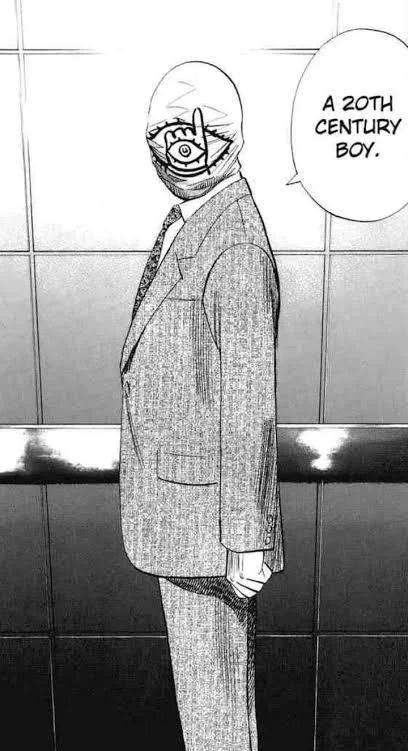
“Friend” is a complex character, representing the result of childhood trauma, struggle with oneself, and ultimately the desire to be noticed. His whole character is practically built on a once “outlier” child who begged to be noticed and also begged to be liked. “Friend” is two different people in the story, but both are rooted in the desire for revenge for how their childhoods went. “Friend” is not just a political allegory in the story that represents government corruption. On the baseline, the story is about how people can be deceived by the government, which is a very important theme, especially in today’s age, but it also shows how some of these awful things in society are rooted in people’s childhoods and development.
The concept of focusing on a villain’s childhood is not something I see many writers gear towards when creating villains, except for a small few. The main one that comes to mind is Darth Vader.
With that being said, I believe that 20th Century Boys is one of the best pieces of manga of all time, possibly even surpassing Berserk, which currently sits at #1 on myanimelist.com. Unfortunately, I do not think the story would ever get an anime adaptation. While the story was being written, three live-action films were released, but the way companies usually market the manga is by releasing the anime simultaneously. The story is far too long and would be easily over 150 episodes. If it were the early 2000s, we would have some hope. Although it may be too late, you never know, as fans around the world can cause something to change.
In the end, you should 100% give 20th Century Boys a read. It is one of the best pieces of media I have ever read and truly hits the mark on themes of family, bonds, moving forward, and fighting for justice.